0%

China’s electric-motor sector serves a fast-growing market, but choosing a manufacturer requires more than comparing catalogue specifications. The International Energy Agency’s Global EV Outlook 2024 reports that electric car sales reached nearly 14 million in 2023, about 18% of global car sales. This figure describes vehicles, not motor shipments. Still, it signals why thermal management, efficiency, and production consistency matter to buyers.

A Liquid-Cooled Electric Motor can help manage heat under demanding operating conditions, including repeated acceleration, heavy loads, and long duty cycles. Its performance depends on more than the cooling jacket. Winding design, insulation, coolant flow, sealing, and manufacturing quality all deserve scrutiny. Small details matter. A poorly documented test result is not proof of reliable field performance.

This guide examines Chinese manufacturers through practical criteria: product range, stated efficiency, thermal limits, testing capability, customization, and after-sales support. Buyers should request verifiable test conditions, performance curves, and references for comparable applications. Standards and certifications can help, but they do not replace application-specific validation. There is no single best supplier for every project. And the evidence is sometimes incomplete. Company claims may use different test methods, making direct comparisons difficult. Readers should treat rankings as a starting point, then confirm specifications with the manufacturer before making a purchasing decision.
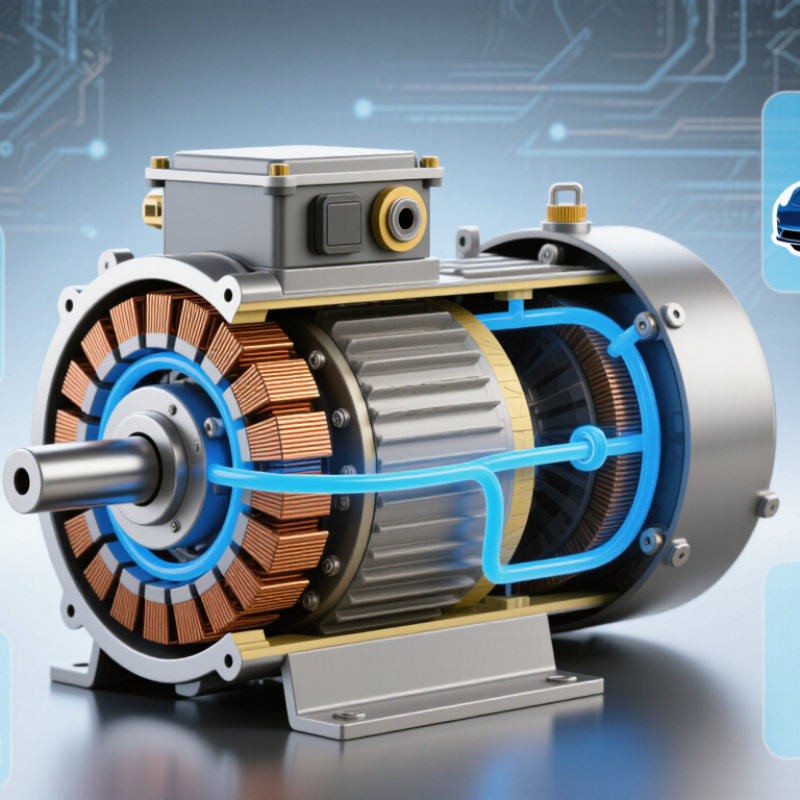
China Best Liquid Cooled Electric Motor Manufacturers?

Liquid-Cooled Electric Motors: IEC 60034-6 IC Cooling-Code Fundamentals

Selecting China’s best liquid-cooled electric motor manufacturer requires more than comparing power ratings. IEC 60034-6 provides a practical language for understanding motor cooling. The IC code identifies how heat moves, which medium carries it, and whether airflow is independent or shaft-driven. This detail often matters more than a polished catalog image.

For example, IC71W usually indicates an enclosed motor with a water jacket. Cooling water flows through the housing, while the internal air remains inside the motor.

IC81W commonly uses an air-to-water heat exchanger mounted on the motor. Internal fans circulate air across the windings and bearings.

IC416 indicates separately powered ventilation, which can maintain cooling at low shaft speeds. The exact construction must match the manufacturer’s datasheet.

Do not treat “liquid-cooled” as a complete specification. Check water temperature, flow rate, pressure, corrosion control, and leak detection. A workshop inspection should also examine hose connections and drain paths near the terminal box. I have seen selection errors caused by assuming a water-cooled motor always performs better. It may not. Poor water quality can reduce heat-transfer performance, while an oversized cooling system can add unnecessary maintenance. Confirm the full IC code, duty cycle, insulation class, bearing arrangement, and test records before approving a motor for continuous service. The code helps, but it does not replace engineering judgment.

Motor Efficiency Classes: IE3 and IE4 Under IEC 60034-30-1

Selecting liquid-cooled electric motor manufacturers requires more than comparing cooling layouts. Efficiency classification matters.

IEC 60034-30-1:2022 defines IE3 and IE4 efficiency classes for many single-speed AC motors. The applicable class depends on rated power, frequency, speed, and operating conditions. IE4 reduces losses more than IE3, but the difference varies by motor size.

For example, an illustrative 500 kW motor may save several kilowatts at full load when efficiency rises from 95.0% to 96.2%. At 8,000 operating hours, that difference can exceed 50 MWh annually. Actual results need verified test data.

The IEA’s Energy Efficiency 2023 report identifies motor-driven systems as a major global electricity load, often representing roughly half of electricity use worldwide. This makes efficiency selection financially important, not merely technical. Liquid cooling can support compact designs, stable winding temperatures, and demanding duty cycles. However, cooling performance does not automatically prove IE4 compliance. Ask manufacturers for IEC-based test reports, declared losses, temperature-rise data, and efficiency curves at partial load. Real installations are less tidy. Pumps, drives, ambient temperature, and maintenance can change results. I would not trust a single nameplate figure without checking the complete motor-drive system and the testing laboratory’s competence. DOE motor-system guidance also emphasizes system-level assessment, because oversizing can erase expected savings.

Comparing Chinese Manufacturers by Power, Torque, IP Rating, and Cooling Design

China Best Liquid Cooled Electric Motor Manufacturers?

Chinese liquid cooled motor manufacturers cover a wide range of power ratings, from compact 5 kW units to industrial systems above 200 kW. Comparing continuous power matters more than peak output. A motor may advertise high peak power, yet overheat during sustained loads. Ask for torque curves, duty-cycle data, and test conditions. A 400 V motor producing 120 Nm continuously may suit a light vehicle better than a larger motor with impressive short-term figures.

Torque delivery should match the application. High starting torque helps conveyors, pumps, and heavy electric vehicles move smoothly. Cooling design directly affects this performance. Jacket cooling surrounds the housing and supports stable operation. End-plate cooling can remove heat near the windings. Spray cooling may improve heat transfer, but it needs careful sealing and maintenance. Check coolant flow, inlet temperature, pressure limits, and service access.

Protection ratings also deserve close attention. IP65 may resist dust and low-pressure water, while IP67 adds temporary immersion protection. IP69K can support demanding washdown environments, but only when the complete assembly is tested. Do not judge the motor alone. Connectors, shafts, and cable glands can become weak points. Request independent test reports and sample inspection records. Measure twice. A neat comparison table can still mislead when efficiency, ambient temperature, or mounting position changes. One practical weakness remains: published data is not always comparable. Field testing is still necessary.

China Best Liquid Cooled Electric Motor Manufacturers? Comparing Chinese Manufacturers by Power, Torque, IP Rating, and Cooling Design

Representative comparison of commonly available Chinese liquid-cooled industrial and traction motor specifications. Values are typical published ranges for comparable motor configurations and should be confirmed against the final technical datasheet.

Comparison Profile Motor Type Continuous Power Peak Power Rated Speed Continuous Torque Peak Torque Ingress Protection Cooling Design Typical Efficiency Common Voltage Range Typical Applications
Profile A
Compact Traction Motor
Permanent-magnet synchronous motor 30–60 kW 60–120 kW 3,000–6,000 rpm 95–190 N·m 190–380 N·m IP65–IP67 Integrated water jacket around the stator housing; optional oil spray for the rotor and bearings 91–95% 300–650 V DC bus Electric utility vehicles, compact construction equipment, AGVs, and light commercial vehicles
Profile B
Medium Traction Motor
Permanent-magnet synchronous motor 80–150 kW 160–300 kW 2,500–5,000 rpm 305–570 N·m 610–1,140 N·m IP67 Cast or machined liquid-cooling jacket with independent inverter and resolver thermal management 93–96% 400–800 V DC bus Electric buses, medium-duty trucks, off-highway vehicles, and hybrid powertrains
Profile C
High-Torque Industrial Motor
Liquid-cooled AC induction motor 75–200 kW 150–350 kW 1,500–3,600 rpm 475–1,270 N·m 950–2,230 N·m IP55–IP66 Closed-loop water-to-air or water-to-water heat exchanger; robust squirrel-cage rotor design 90–94% 380–690 V AC or inverter supply Winches, pumps, compressors, conveyors, cranes, and heavy industrial machinery
Profile D
Heavy-Duty Traction Motor
Permanent-magnet synchronous motor 150–300 kW 300–600 kW 1,800–4,500 rpm 800–1,590 N·m 1,600–3,180 N·m IP67–IP68 Dual-circuit liquid cooling for the stator and end covers; optional direct oil cooling for high-load duty cycles 94–97% 600–1,000 V DC bus Heavy electric trucks, mining vehicles, large buses, marine propulsion, and high-load drivetrains
Profile E
High-Speed Motor
High-speed permanent-magnet synchronous motor 100–250 kW 200–450 kW 6,000–15,000 rpm 64–398 N·m 128–796 N·m IP65–IP67 Pressurized liquid jacket with rotor oil mist or oil spray cooling; requires high-speed bearing management 93–96% 400–800 V DC bus Electric compressors, turbo-machinery, hybrid generators, and high-speed industrial drives
Profile F
Low-Speed Direct-Drive Motor
Permanent-magnet synchronous motor 50–180 kW 100–360 kW 300–1,500 rpm 1,590–5,730 N·m 3,180–11,460 N·m IP66–IP68 Large-area water jacket with enhanced end-winding cooling; designed to eliminate or reduce mechanical gearing 92–96% 400–800 V DC bus or variable-frequency AC supply Direct-drive winches, propulsion systems, mixers, extruders, elevators, and heavy-duty pumps
Profile G
High-Temperature Industrial Motor
Liquid-cooled synchronous or induction motor 200–500 kW 400–900 kW 1,000–3,000 rpm 1,270–4,775 N·m 2,540–9,550 N·m IP55–IP67 Redundant liquid-cooling circuit with temperature sensors in the windings, bearings, and coolant channels 92–96% 690 V AC or medium-voltage inverter supply Steel processing, marine auxiliaries, large compressors, energy equipment, and continuous-process plants

Torque values are calculated from rated power and speed using T = 9550 × P(kW) ÷ n(rpm). Actual continuous and peak torque depend on winding temperature, inverter current, duty cycle, coolant flow rate, ambient temperature, and mechanical limits. IP ratings should be verified for the complete motor assembly and cable interfaces.

Applications in EVs and Industry: Thermal Loads, Duty Cycles, and Operating Conditions

Selecting liquid-cooled electric motor manufacturers requires more than comparing rated power. In EVs, thermal load changes sharply during acceleration, climbing, towing, and regenerative braking. Copper losses heat the windings, while iron and bearing losses raise rotor and housing temperatures. A liquid jacket can remove heat quickly, but coolant flow, inlet temperature, and channel design determine real performance. Bench ratings alone are not enough.

A practical evaluation should match the motor to its duty cycle. Urban delivery vehicles may repeat short bursts, frequent stops, and long idle periods. Heavy electric vehicles can demand high torque for several minutes, then descend with limited cooling airflow. Industrial pumps often run continuously, while conveyors face repeated starts and overloads. Engineers should request temperature maps, continuous and peak torque curves, pressure-drop data, insulation limits, and tests at representative coolant temperatures. These details reveal whether a motor suits the application or only the laboratory.

Operating conditions deserve equal attention. Dust, humidity, vibration, altitude, and low ambient temperatures can change seals, viscosity, and heat transfer. In factories, restricted ventilation may make coolant quality and filtration critical. In EVs, software limits can protect the motor, yet aggressive derating may reduce usable power. A field trial with sensors on windings, coolant inlet, outlet, and housing gives stronger evidence than one brochure value. I have seen promising prototypes underperform after repeated thermal cycles. That result is uncomfortable, but useful. Test assumptions need revision.

Explanation: The chart presents representative motor-loss components as a percentage of rated electrical input during continuous operation. Copper losses normally increase with load current, while iron and mechanical or stray losses remain comparatively stable. EV traction motors are commonly exposed to repeated acceleration and regenerative-braking cycles, whereas pumps, compressors, and conveyors may operate for long periods under S1 continuous-duty conditions. Actual thermal load depends on motor efficiency, speed, ambient temperature, coolant inlet temperature, airflow, load profile, and installation conditions.
Values are representative engineering design points based on common operating ranges and are not company- or brand-specific performance data.

Supplier Evaluation: Testing, Certification, Customization, and After-Sales Support

China Best Liquid Cooled Electric Motor Manufacturers?

Choosing a liquid cooled motor supplier requires evidence, not attractive catalog numbers. The International Energy Agency reports that electric motor systems consume roughly 50% of global electricity. Small efficiency losses can therefore become large operating costs. Request efficiency curves, thermal-rise results, vibration data, and insulation test records for the exact model. IEC 60034 standards should guide performance, temperature, cooling, and protection checks. A serious supplier can explain test conditions clearly, including coolant flow, ambient temperature, and load duration. Vague certificates deserve caution.

Customization must match the application, not merely change the flange. Confirm torque-speed range, duty cycle, coolant chemistry, hose position, shaft tolerance, encoder interface, and mounting dimensions. Ask whether prototypes receive endurance testing before production approval. ISO 9001 certification supports process control, but it does not prove motor quality by itself. The U.S. Department of Energy has linked motor-driven systems to about 46% of global electricity use. This makes verified efficiency more valuable than a low purchase price. Still, laboratory data can miss field problems. Real installation feedback matters.

Tips: Ask for a witnessed factory acceptance test and serial-level test records. Check third-party certification validity directly. Require a written after-sales plan covering spare seals, replacement bearings, response times, fault analysis, and software support. Keep coolant samples and operating logs. They can reveal contamination or overheating early. One uncomfortable question helps: what failures occurred in the last twelve months, and what changed afterward? A supplier unwilling to answer may still deliver, but the risk is poorly measured.

FAQS

What does the IEC 60034-6 IC code explain?

It describes how motor heat moves, which cooling medium is used, and how airflow is produced. The code supports engineering decisions, but it does not replace testing.

What does IC71W usually indicate?

IC71W usually describes an enclosed motor with a water jacket. Water flows through the housing while internal air remains inside.

How does IC81W differ from IC71W?

IC81W commonly uses an air-to-water heat exchanger. Internal fans move air across the windings and bearings.

Why might IC416 suit low-speed operation?

IC416 uses separately powered ventilation. Cooling can continue when the motor shaft rotates slowly or stops.

Is “liquid-cooled” enough when selecting a motor?

No. Check coolant temperature, flow rate, pressure, corrosion control, and leak detection. A label alone says too little.

Which motor ratings matter for electric vehicles and industrial equipment?

Continuous power and torque matter more than peak figures. Ask for torque curves, duty-cycle data, and test conditions.

How should protection ratings be evaluated?

IP65 resists dust and low-pressure water. IP67 adds temporary immersion protection. IP69K supports demanding washdown conditions when the complete assembly is tested.

What physical details should an inspection include?

Examine hose connections, drain paths, terminal-box areas, connectors, shafts, and cable glands. These small points can become serious leak or sealing weaknesses.

How can real thermal performance be verified?

Run a field trial with sensors on the windings, coolant inlet, coolant outlet, and housing. Test repeated acceleration, overloads, stops, or continuous operation.

Why can published motor data be difficult to compare?

Efficiency and temperature results may use different ambient conditions, mounting positions, coolant temperatures, and duty cycles. The table may look neat, yet still hide important differences.

What operating conditions deserve attention beyond power and torque?

Review dust, humidity, vibration, altitude, coolant quality, filtration, and low temperatures. These conditions can change sealing, viscosity, and heat transfer.

Conclusion

This guide explains how to evaluate a Liquid-Cooled Electric Motor by focusing on cooling standards, efficiency, performance, and application requirements. It introduces IEC 60034-6 IC cooling codes and clarifies how IE3 and IE4 efficiency classes under IEC 60034-30-1 relate to energy consumption and operating costs. Chinese manufacturers can be compared through key specifications such as rated power, torque, protection rating, thermal management structure, noise control, and expected service life.

The article also examines the use of liquid-cooled motors in electric vehicles and industrial equipment, where thermal loads, duty cycles, ambient conditions, and installation environments strongly affect motor selection. A reliable supplier should provide appropriate testing data, certification support, customization options, production consistency, and responsive after-sales service. By reviewing these factors together, buyers can select a motor that delivers stable performance, efficient heat dissipation, dependable operation, and compatibility with their specific system requirements.


Clara

Clara

Clara is a professional marketing specialist with a strong understanding of the company’s products and the needs they are designed to meet. She regularly contributes expert blog articles to the company website, translating product knowledge and industry insights into clear, useful guidance for......