0%

Why choose a Smart Touchscreen Motorcycle Dash when a traditional gauge already shows speed and fuel? The answer begins with changing riding conditions. On a bright morning, a clear display can keep essential information visible through tinted lenses. In light rain, a sealed unit may offer more confidence than a phone balanced on the handlebar. A Smart Touchscreen Motorcycle Dash can combine navigation, trip data, phone connectivity, and vehicle information in one compact screen.

The practical value depends on thoughtful design, not a long feature list. Riders should check daylight readability, glove operation, mounting stability, water resistance, viewing angles, and software support. A screen that responds slowly at a junction becomes a problem, not an upgrade. Installation also matters. Loose brackets can create vibration, blurred images, or damaged wiring over time. A qualified technician or careful reference to the manufacturer’s manual can reduce those risks.

It is not perfect.

Touch controls may demand attention when traffic becomes complex. Voice guidance can be useful, yet unfamiliar roads still require judgment. Compatibility differs between motorcycle models, phones, and electronic systems. Buyers should verify specifications through official documentation and independent testing before spending money. A reliable dashboard should support safer decisions, not encourage constant screen watching. The strongest reason to choose one is simple: it can present useful information closer to the rider’s natural line of sight. Still, convenience should never replace observation, road awareness, or regular checks of the motorcycle itself.
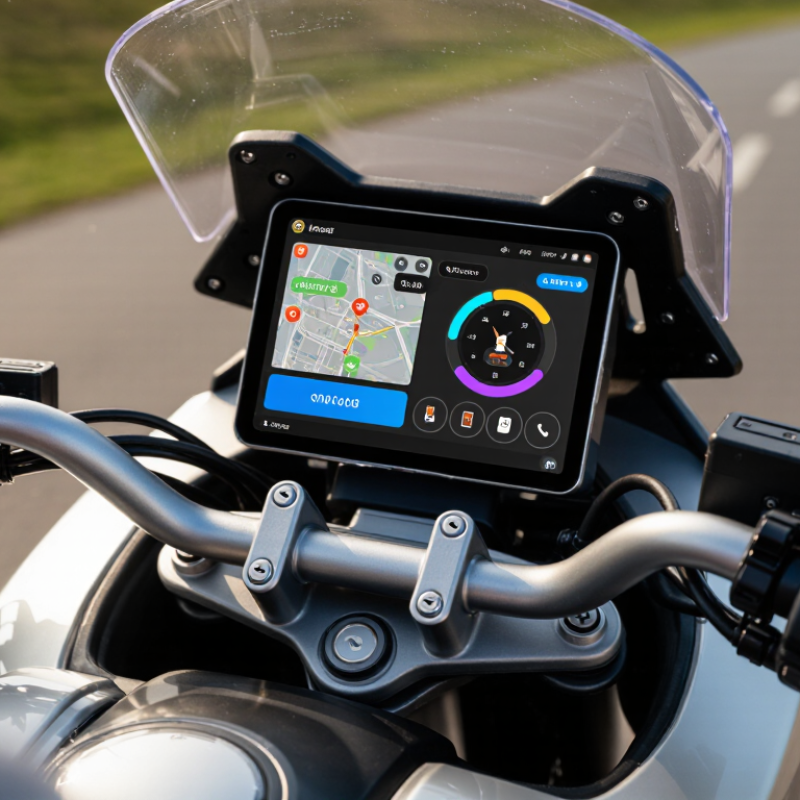
Why Choose a Smart Touchscreen Motorcycle Dash?

Motorcycle Risk Context: NHTSA Reports 28× Higher Fatality Risk per Mile

Why Choose a Smart Touchscreen Motorcycle Dash?

Motorcycle Risk Context: 28× Higher Fatality Risk per Mile

Motorcycling offers freedom, but the exposure is serious. NHTSA reported that motorcyclists faced 28 times the fatality risk per vehicle mile compared with passenger-car occupants. This figure comes from Traffic Safety Facts: Motorcycles, based on 2016 data. The same report recorded 5,337 motorcyclist deaths that year. Recent NHTSA data also shows that motorcycles remain highly vulnerable in traffic crashes.

A smart touchscreen motorcycle dash can place navigation, speed, alerts, and vehicle information within one view. That may reduce repeated glances toward a phone or separate device. It cannot remove risk. A bright screen, complex menus, or poor mounting can create new distractions. I have found that simple controls matter more than impressive features. Riders should test the interface with gloves before trusting it on unfamiliar roads. Weather, vibration, and glare can also affect usability.

Tips: Set the route before moving. Use large icons and clear audio prompts. Keep essential information visible. Check the screen only during safe pauses. If a feature demands attention, disable it. A dash should support judgment, not replace it. NHTSA and the Insurance Institute for Highway Safety both emphasize protective equipment, visibility, and rider attention. Those basics still matter more than any display. One honest weakness remains: technology may encourage overconfidence. A screen cannot predict every driver, road defect, or sudden change.

Smart Dash Functions: GPS, TPMS, Bluetooth, and Real-Time Ride Data

Why Choose a Smart Touchscreen Motorcycle Dash?

A smart touchscreen motorcycle dash turns scattered ride information into one visible control point. GPS navigation can show upcoming turns without forcing you to handle a phone. Clear route prompts matter when rain, gloves, and traffic reduce attention. Still, GPS can lose accuracy near tunnels or tall buildings.

TPMS TPMS displays tire pressure and temperature in real time. That information helps riders notice slow leaks before handling becomes unpredictable.

Bluetooth Bluetooth connects a phone, helmet headset, or other approved device for calls and audio prompts.

Real-time ride data can include speed, trip distance, voltage, and engine conditions. These readings support better decisions, but they are not a substitute for regular inspections. I still check tire pressure manually. The screen is not magic.

Tips

Mount the dash where it stays visible without blocking essential controls.

Test the GPS route before riding, especially in remote areas.

Pair Bluetooth devices while parked, not during motion.

Check TPMS readings after the tires cool, because heat changes pressure.

Keep the display brightness moderate at night. Touch controls can feel less precise with wet gloves. That small weakness deserves attention.

Review software settings before every long ride, and confirm alerts are easy to understand. A reliable dash should reduce distraction, not create another one.

Safety Evidence: ABS Lowers Motorcycle Fatal Crash Rates by 22% (IIHS)

Why Choose a Smart Touchscreen Motorcycle Dash?

Anti-lock braking is not a luxury feature. It can change the outcome of a sudden stop. The Insurance Institute for Highway Safety reported a 22% lower fatal crash rate for motorcycles equipped with ABS. This finding compares similar motorcycles with and without the system. The evidence is strong, but it is not a guarantee.

A smart touchscreen dash can make safety information easier to notice. A clear ABS warning, tire-pressure alert, or brake-system message may appear near the rider’s normal sightline. That matters when rain darkens the road or traffic stops unexpectedly. The National Highway Traffic Safety Administration identifies braking errors, poor visibility, and rider distraction as important motorcycle safety concerns. A well-designed interface should reduce searching, not add another task.

Use it briefly. Keep your eyes moving.

Touch control is not always ideal with wet gloves. Glare can also make a bright display difficult to read. I still question any design that encourages riders to adjust settings while moving. Physical controls, simple icons, and strong contrast may work better in real traffic. IIHS safety research supports ABS, but responsible riding still depends on training, speed control, protective equipment, and attention. A touchscreen should support those habits, not pretend to replace them.

Display Engineering: Compare IP67 Protection, Glove Use, and 1,000-Nit Brightness

Why Choose a Smart Touchscreen Motorcycle Dash?

A motorcycle dash faces dust, spray, vibration, and sudden temperature changes. IP67 protection offers meaningful reassurance during daily riding. The rating indicates complete dust protection and water resistance during temporary immersion. However, it does not make the unit invincible. High-pressure washing can exceed laboratory conditions. I still prefer a gentle rinse and careful inspection after muddy trips. That small routine prevents assumptions from becoming expensive repairs.

Brightness matters when the road opens into direct sunlight. A 1,000-nit display can keep maps and warning information readable beneath harsh midday glare. Yet brightness alone does not guarantee perfect visibility. Screen coating, viewing angle, and reflected sky also affect clarity. Glove use deserves equal attention. A well-tuned capacitive touchscreen should recognize deliberate taps through common riding gloves. Thick winter gloves may respond slowly, especially when moisture reaches the fingertips. That limitation is easy to overlook.

Tips: Test the dash with your actual gloves before installation. Try wet-weather controls while parked, not while moving. Keep essential buttons large and widely spaced. Check the screen at sunrise, noon, and dusk. If you must press repeatedly, the interface needs improvement. A short road test reveals more than a specification sheet.

Why Choose a Smart Touchscreen Motorcycle Dash?

Display engineering reference benchmarks for IP67 protection and a 1,000-nit screen. IP67 means complete dust protection and temporary immersion in up to 1 metre of water for up to 30 minutes. Glove operation is application-dependent and should be validated with the intended glove, screen protector, and touch controller.

Normalized reference score: IP dust rating uses 6/6, water rating uses 7/9, and brightness uses 1,000/1,000 nits. IP ratings are defined by IEC 60529.

Buying Criteria: Evaluate Connectivity, Navigation Accuracy, and Update Support

A smart touchscreen motorcycle dash earns its place through dependable connectivity, not visual novelty. The 2024 Mobile Economy report projected 5G connections would reach 2.3 billion worldwide by the end of 2024. That growth supports faster traffic data and cloud services. However, riders still need offline maps when cellular coverage disappears. Check whether routes, weather, and emergency contacts remain usable without a phone signal. Test it outdoors. A bright screen should remain readable through glare, rain, and riding gloves.

Navigation accuracy deserves practical testing. GPS.gov states that open-sky positioning can usually reach about 4.9 meters of accuracy. Buildings, tunnels, trees, and interference can reduce that performance sharply. The 2024 Global Traffic Scorecard estimated that drivers in major markets lost dozens of hours in congestion. Therefore, live traffic data can save time, but only when updates arrive quickly. Compare a displayed route with actual road closures. That gap matters. Voice prompts should arrive before a turn, not beside it.

Update support is easy to overlook. Ask how often map data changes, how long security patches continue, and whether updates work through Wi-Fi or a phone. Clear version histories show stronger technical discipline. Automatic updates sound convenient, yet failed installations can leave a dash unusable. I would prefer manual recovery options and downloadable maps. No system is perfect. Riders should also confirm compatibility after every phone or operating-system upgrade. A polished interface cannot compensate for neglected software.

Why Choose a Smart Touchscreen Motorcycle Dash? — Buying Criteria: Evaluate Connectivity, Navigation Accuracy, and Update Support

Evaluation Dimension What to Look For Practical Benchmark or Fact How to Verify Before Buying Why It Matters on a Motorcycle
Smartphone Connectivity Stable wireless connection for calls, music, notifications, and navigation data. Bluetooth is commonly used for short-range device communication; Wi-Fi can support faster map downloads and software updates. Check supported Bluetooth profiles, pairing instructions, reconnection behavior, and whether Wi-Fi is built in. Reliable pairing reduces distractions and prevents repeated stops to reconnect devices.
Helmet Intercom Compatibility Compatibility with Bluetooth headsets or helmet communication systems. A dash may support only standard Bluetooth audio or may offer broader intercom integration; these are not equivalent. Confirm supported audio profiles and test music, navigation prompts, and incoming-call audio with the intended headset. Navigation instructions are more useful when they can be heard without looking away from the road.
GNSS Position Accuracy Reception from GPS and, where available, additional satellite systems such as Galileo, GLONASS, or BeiDou. Consumer GNSS positioning is often accurate to a few meters in open-sky conditions, but accuracy can decrease near buildings, tunnels, trees, and heavy electrical interference. Review the supported satellite systems and compare the displayed route with a known road during an outdoor test ride. Accurate positioning improves turn timing, lane guidance, and rerouting decisions.
Navigation Route Quality Clear turn prompts, visible road names, lane information, rerouting, and motorcycle-friendly route options. Offline navigation should retain core map guidance when mobile coverage is unavailable; live traffic and weather normally require an active data connection. Download a map area, disable mobile data, and test search, route calculation, recalculation, and voice prompts. Riders may travel through rural areas, tunnels, or regions with weak cellular coverage.
Map and Software Updates Transparent update process, update history, file size, compatibility, and long-term support. Road layouts and traffic rules change regularly; update availability should be stated clearly rather than assumed. Look for update instructions, release notes, update frequency, storage requirements, and whether updates can be completed over Wi-Fi. Current maps reduce incorrect turns and improve compatibility with newly opened or changed roads.
Mobile Data Requirements Whether the dash requires a phone connection, a SIM/eSIM, or works fully offline. Cloud services, live traffic, weather, and remote features generally need internet access; stored maps can provide basic offline guidance. Identify which functions stop working when the phone is disconnected or has no cellular signal. This affects operating cost, touring convenience, and performance in remote areas.
Screen Visibility Brightness, anti-glare treatment, viewing angle, automatic brightness, and glove-friendly controls. A screen that remains readable in direct sunlight and at night is more important than resolution alone. View the display in direct sunlight, with polarized sunglasses, at night, and while wearing riding gloves. Poor visibility can cause longer glances away from traffic and increase rider workload.
Weather and Water Protection Published ingress-protection rating, sealed connectors, and resistance to vibration and temperature changes. An IP67 rating means dust-tight protection and temporary immersion in water up to 1 meter for up to 30 minutes under IEC 60529 test conditions. Check the official IP rating and installation requirements; inspect whether charging ports remain exposed during rain. Motorcycle electronics face rain, spray, dust, road debris, and rapid weather changes.
Power and Wiring Vehicle-voltage compatibility, low-power standby behavior, fuse protection, and clean cable routing. The product should specify its input-voltage range and recommended fuse or power connection method. Compare the electrical specifications with the motorcycle battery and inspect the installation manual before purchase. Incorrect wiring can cause shutdowns, battery drain, or damage to the motorcycle’s electrical system.
Mounting and Vibration Control Secure mounting hardware, vibration isolation, adjustable viewing angle, and compatibility with the handlebar diameter. The mount should be rated or documented for motorcycle use rather than only for low-vibration automotive interiors. Check mounting dimensions, fastener quality, clearance from controls, and stability on rough-road surfaces. A stable screen is easier to read and less likely to suffer connector or display damage.
Touch and Glove Operation Large touch targets, physical shortcut controls, wet-touch behavior, and compatibility with common riding gloves. Capacitive screens can respond poorly to thick gloves or water unless the interface and hardware are designed for those conditions. Test zooming, route confirmation, menu access, and emergency cancellation with the gloves normally used for riding. Simple controls reduce the time and attention required for each interaction.
Support and Serviceability Warranty terms, troubleshooting documentation, replacement parts, and support response channels. A clear support policy should identify warranty duration, coverage limits, software support process, and repair or replacement options. Read the warranty and support pages before purchase and confirm how failed hardware or corrupted updates are handled. A navigation device is most valuable when it remains usable throughout its service life.

Note: Performance varies with satellite visibility, weather, road environment, phone compatibility, cellular coverage, installation quality, and software support. Product specifications should be verified against the latest official documentation before purchase.

FAQS

Why use a smart touchscreen motorcycle dash?

It combines navigation, speed, alerts, and vehicle information in one view. Fewer devices can mean fewer repeated glances. It cannot remove riding risks.

How serious is motorcycle travel risk?

Motorcyclists face much higher fatality risks per mile than passenger-car occupants. Traffic conditions change quickly. Protective equipment and attention remain essential.

Can a dash prevent crashes?

No. It supports decisions but cannot predict careless drivers, road defects, or sudden changes. Technology may create overconfidence. That concern deserves honest attention.

What does IP67 protection mean?

IP67 indicates strong dust protection and resistance to temporary water immersion. It is not invincible. Avoid high-pressure washing near the device.

Is a 1,000-nit screen bright enough?

It can improve readability under strong midday sunlight. Glare, viewing angle, and screen coating still matter. Test it at noon.

Will the touchscreen work with motorcycle gloves?

A well-tuned capacitive screen can recognize deliberate taps through common riding gloves. Thick winter gloves may respond slowly. Wet fingertips make control harder.

Does navigation work without cellular coverage?

Reliable offline maps are important when signals disappear in tunnels, forests, or remote roads. Test downloaded routes before leaving. Do not assume every feature works offline.

How accurate is motorcycle dash navigation?

Open-sky positioning may reach roughly five meters of accuracy. Buildings, trees, tunnels, and interference can reduce precision. Displayed routes still need practical checking.

What should riders check before buying?

Check glove operation, sunlight visibility, offline maps, update methods, and phone compatibility. Try the dash while parked. A short road test reveals weaknesses.

How should riders use the dash safely?

Set routes before moving and keep essential information visible. Use large icons and clear voice prompts. Check the screen only during safe pauses.

Conclusion

A Smart Touchscreen Motorcycle Dash can improve both rider awareness and everyday convenience in a high-risk riding environment. Because motorcyclists face a much higher fatality risk per mile than occupants of passenger vehicles, having clear, timely information is especially valuable. A modern dash can combine GPS navigation, tire-pressure monitoring, Bluetooth connectivity, and real-time ride data in one accessible display, helping riders monitor routes, vehicle condition, and essential alerts without relying on multiple devices.

When choosing a system, riders should focus on practical performance rather than appearance alone. Important considerations include IP67 protection against dust and water, reliable glove-friendly controls, and brightness of around 1,000 nits for better visibility in sunlight. Safety technologies also matter: evidence indicates that ABS can reduce motorcycle fatal crash rates by approximately 22%. Buyers should additionally evaluate connection stability, navigation accuracy, software update support, and ease of installation. A well-designed dash should provide useful information while minimizing distraction and supporting safer, more informed riding.


Clara

Clara

Clara is a professional marketing specialist with a strong understanding of the company’s products and the needs they are designed to meet. She regularly contributes expert blog articles to the company website, translating product knowledge and industry insights into clear, useful guidance for......